
Document Management System and its benefits for your business
What is Document Management System?
Simply put, a document
management system is a software program solution specifically designed with the
purpose of organizing, securing, capturing, digitizing, tagging, approving, and
completing tasks on your business files.
In every company or
organization, there will always be a form of document management that involves
the process of capturing, storing, and retrieving documents in its daily
operations. Now, the focus is that the processes implemented are often
time-consuming, so they are often ignored or not seen as a priority in
decision-making.
Meanwhile, every company or
organization needs to have an efficient DMS system so that the process does not
end up being a waste of time. And it is for this reason that today's systems
utilize computer systems or cloud software to store and manage electronic
documents.
How is DMS Used in Organizational Activities?
Document management systems
are used to capture and organize all kinds of documents into an electronic form
that is easy to find and retrieve when needed. In this case, a document is
defined as any kind of object or information that is recorded and viewed as a
unit of data.
What about physical documents
or paper documents such as invoices? For this kind of document, the document
will be scanned first and then integrated into the system in electronic form so
that it can be retrieved at a later date.
Documents will then be indexed
based on their category. For example, department or division, sequence number,
vendor, or other relevant categories for your company. Unlike traditional
document management that is still manual and uses folders, Document Management
System stores documents in electronic form that can be accessed more easily by
authorized personnel or clients.
By using centralized
electronic storage such as cloud storage and software provided by Document
Management System vendors, you can easily search and retrieve any document in
just seconds. This fast document retrieval can also increase your business
productivity, especially in terms of document administration and management.
What are the Essential Components of a DMS?
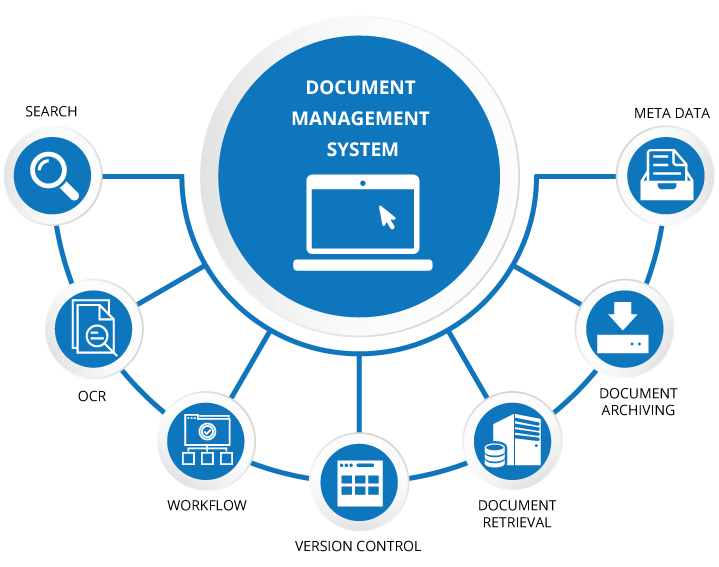
1. Document metadata.
Generally, each document is
stored along with its metadata. These include the date and time of storage, the
name of the person who stored the document, and the format of the document. The
document management system can either retrieve the metadata itself or ask the
user to provide the required information.
2. Document capture.
Document capture refers to the
processing of physical documents by scanning them so that they can be stored in
electronic format. Some systems use OCR (optical character recognition)
software to convert digital images from scanned documents into readable text.
The capture process also includes receiving documents in electronic format and
other digital files into the system.
3. Indexing.
The indexing process can help
users track electronic documents stored in the system. This indexing can be as simple
as tracking the identification of documents in the system, or even a specific
classification for each document based on word indices or metadata extracted
from the content of each document.
This process is very important
in a DMS program. This is because indexing helps make the document retrieval
process faster, more efficient, and more accurate.
4. Storage.
This component deals with how
documents are stored in a central repository for later retrieval. Storage
includes the specific locations where each document is stored in the system,
the duration of storage, the migration of documents through different storage
media, and the eventual destruction of documents.
5. Document withdrawal.
Document retrieval is a key
element in document management systems, which deals with how documents are
retrieved from central storage. The process of retrieval is complex as it also
deals with access and permissions to individual documents. In document retrieval,
users can access documents based on desired unique identifiers, such as
metadata and specific search terms.
6. Versioning.
Basically, versioning is the
process by which documents are inserted or removed from the system, and allows
users to access the current or previous version of the document. Since
documents will inevitably be updated from time to time, versioning is needed to
ensure that users can still access copies of previous versions for reference.
7. Search.
Through search, users can find
specific documents or folders using attribution or full-text search.
Attributions include document titles, tags, and other metadata.
8. Division or
distribution.
In an efficient document
management system, the distribution or sharing process of documents, parts of
documents, folders, or even entire accounts can be set up to be done by
authorized personnel. The system can also grant permission to view documents
("View") or edit ("Edit") for users with permission to edit
metadata.
9. Document security.
And of course, document
security cannot be ignored in a document management system. Moreover, advances
in digital technology are unfortunately also accompanied by the sophistication
of security threats such as crypto-ransom malware. Therefore, storing documents
in a secure central repository is a must.
Another security aspect that
also needs to be considered is backing up. Without document backups, your
company has the potential to suffer tremendous losses, especially if there is a
virus or hacker attack to a natural disaster or fire.
What are the Benefits of DMS for Your Company?
A sophisticated document
management system can handle large volumes of document flow so that the entire
company's human resources can use their time and energy to increase
productivity.
The benefits you can
experience through the implementation of a document management system include:
- Easily manage documents through a document management system specifically designed for business and organizational needs.
- Save time, because in business time is money. If more personnel time is used for unproductive tasks, of course this will also have an impact on the company's performance.
- Peace of mind as document security risks are minimized through a sophisticated security system.
Source : indonesiancloud.com


